Tuesday, July 4, 2017

Proper 9A: 5th Sunday after Pentecost 2017

1st Reading (Track 1):  Genesis 24:34-38, 42-49, 58-67
Sarah has died (chapter 23), and it is now time for Abraham to secure a wife for his son Isaac. Isaac has not been mentioned since his near sacrifice in chapter 22, and he does not appear in this story until the very end. Abraham is determined to find a wife for Isaac “back home” in Haran. The story includes several Mid-eastern betrothel rituals, including the nose ring. We skip the negotiation of a dowry (vv. 50-57). The entire story continues several large themes of the Abraham story:  Abraham is blessed by God; God is loyal and faithful to Abraham and Abraham is loyal and faithful to God.  Abraham acts within the pruposes and provisions of his God.

24:34 The man said to Rebekah and her household, “I am Abraham’s servant. 35 The Lord has greatly blessed my master, and he has become wealthy; he has given him flocks and herds, silver and gold, male and female slaves, camels and donkeys. 36 And Sarah my master’s wife bore a son to my master when she was old; and he has given him all that he has. 37 My master made me swear, saying, ‘You shall not take a wife for my son from the daughters of the Canaanites, in whose land I live; 38 but you shall go to my father’s house, to my kindred, and get a wife for my son.’ 42 I came today to the spring, and said, ‘O Lord, the God of my master Abraham, if now you will only make successful the way I am going! 43 I am standing here by the spring of water; let the young woman who comes out to draw, to whom I shall say, ‘Please give me a little water from your jar to drink,’ 44 and who will say to me, ‘Drink, and I will draw for your camels also’—let her be the woman whom the Lord has appointed for my master’s son.’ 45 Before I had finished speaking in my heart, there was Rebekah coming out with her water jar on her shoulder; and she went down to the spring, and drew. I said to her, ‘Please let me drink.’ 46 She quickly let down her jar from her shoulder, and said, ‘Drink, and I will also water your camels.’ So I drank, and she also watered the camels. 47 Then I asked her, ‘Whose daughter are you?’ She said, ‘The daughter of Bethuel, Nahor’s son, whom Milcah bore to him.’ So I put the ring on her nose, and the bracelets on her arms. 48 Then I bowed my head and worshiped the Lord, and blessed the Lord, the God of my master Abraham, who had led me by the right way to obtain the daughter of my master’s kinsman for his son. 49 Now then, if you will deal loyally and truly with my master, tell me; and if not, tell me, so that I may turn either to the right hand or to the left.” 58 And they called Rebekah, and said to her, “Will you go with this man?” She said, “I will.” 59 So they sent away their sister Rebekah and her nurse along with Abraham’s servant and his men. 60 And they blessed Rebekah and said to her, “May you, our sister, become thousands of myriads; may your offspring gain possession of the gates of their foes.” 61 Then Rebekah and her maids rose up, mounted the camels, and followed the man; thus the servant took Rebekah, and went his way. 62 Now Isaac had come from Beer-lahai-roi, and was settled in the Negeb. 63 Isaac went out in the evening to walk in the field; and looking up, he saw camels coming. 64 And Rebekah looked up, and when she saw Isaac, she slipped quickly from the camel, 65 and said to the servant, “Who is the man over there, walking in the field to meet us?” The servant said, “It is my master.” So she took her veil and covered herself. 66 And the servant told Isaac all the things that he had done. 67 Then Isaac brought her into his mother Sarah’s tent. He took Rebekah, and she became his wife; and he loved her. So Isaac was comforted after his mother’s death.

Canticle (Track 1): Song of Solomon 2:8-13 (A Song of My Beloved)
The Song of Solomon (or “The Song of Songs”) is a series of love poems attributed to King Solomon, but most likely written at a much later date. Today’s portion is from a longer poem (8-17) that opens and closes with the image of the beloved as a gazelle. Commentators from early times have seen these poems as an allegory of the love between God and Israel (or in Christian terms, Christ and the church).

Hear the voice of my belovéd! *
                Over the mountains he comes leaping,
bounding over the hills *
                like a young stag or a gazelle.
See where he stands behind our wall, *
                gazing in the windows,
                peeking through the lattice.
My belovéd says to me: *
                Rise up, my love, my beauty, come away;
for now the winter is past, *
                the rains are over and gone.
Flowers appear on the earth *
                and the time of singing has come:
the voice of the turtle-dove *
                is heard throughout our land.
The fig trees bend with scented fruit; *
                and all the squash-vines blossom,
sending up their sweet perfume. *
                Rise up, my love, my beauty, and come away.

Or this

Psalm 45:11-18 (Track 1)
Psalm 45 is unique among the Psalms in that its use in ancient Israel was clearly for a royal wedding. In the opening verses of the psalm (1-10), the king is extolled and highly idealized. In verse 11, the queen enters. Because of the emphasis in verse 11, she may have been from a foreign land. The role of the queen betrays its ancient setting. The final two verses are a blessing on the king. The “I” is the writer, not God (see the opening verse of the psalm).

11 Hear, O daughter; consider and listen closely; *
                forget your people and your father’s house.
12 The king will have pleasure in your beauty; *
                he is your master; therefore do him honor.
13 The people of Tyre are here with a gift; *
                the rich among your people seek your favor.
14 All glorious is the princess as she enters; *
                her gown is cloth-of-gold.
15 In embroidered apparel she is brought to the king; *
                after her the bridesmaids follow in procession.
16 With joy and gladness they are brought, *
                and enter into the palace of the king.
17 In place of fathers, O king, you shall have sons; *
                you shall make them princes over all the earth.
18 I will make your name to be remembered
      from one generation to another; *
                therefore nations will praise you for ever and ever.

1st Reading (Track 2):  Zechariah 9:9-12
Zechariah prophesied as the Babylonian exiles returned to rebuild Jewish society with those who had been left behind (around 520—518 b.c.e.), although the second half of the book (chapters 9-14) might have been from a later period, perhaps even after Alexander the Great had conquered the region (after 330 b.c.e.). Verses 9 & 10 of our reading seem to describe the return of a king to Jerusalem (Christians have generally seen the entrance of Jesus on “Palm Sunday” in these verses, which are quoted in Matthew 21:5-7). Verses 11 & 12 celebrate the return of the people with the moving image, “prisoners of hope.”

9:9 Rejoice greatly, O daughter Zion! Shout aloud, O daughter Jerusalem! Lo, your king comes to you; triumphant and victorious is he, humble and riding on a donkey, on a colt, the foal of a donkey. 10 He will cut off the chariot from Ephraim and the war-horse from Jerusalem; and the battle bow shall be cut off, and he shall command peace to the nations; his dominion shall be from sea to sea, and from the River to the ends of the earth. 11 As for you also, because of the blood of my covenant with you, I will set your prisoners free from the waterless pit. 12 Return to your stronghold, O prisoners of hope; today I declare that I will restore to you double.

Psalm 145:8-15 (Track 2)
Psalm 145 as a whole is an acrostic poem, most likely intended for use in worship, as it sings the praises of God. Verse 8 repeats the creed of Exodus 34:6 (see also Psalm 86:5).

8    The Lord is gracious and full of compassion, *
                slow to anger and of great kindness.
9    The Lord is loving to everyone *
                and his compassion is over all his works.
10 All your works praise you, O Lord, *
                and your faithful servants bless you.
11 They make known the glory of your kingdom *
                and speak of your power;
12 That the peoples may know of your power *
                and the glorious splendor of your kingdom.
13 Your kingdom is an everlasting kingdom; *
                your dominion endures throughout all ages.
14 The Lord is faithful in all his words *
                and merciful in all his deeds.
15 The Lord upholds all those who fall; *

2nd Reading:  Romans 7:15-25a
There has long been debate about just to whom the “I” refers in this passage. The obvious answer is Paul, but this does not jive with his claim in other places to be “blameless” under the law (for example, Philippians 3:5-6). Whichever is the case, Paul clearly intends here to show the desperation one experiences “under the law,” without the rescue of the grace available through relationship with Christ. Must we live as “wretched men [sic]”? No, there is another way, “through Jesus Christ our Lord.” Then at the beginning of chapter 8 Paul will say a most stunning thing, especially considering the angst he has just dwelled upon.  He says, “There is therefore now no condemnation for those who are in Christ Jesus.”

7:10 I do not understand my own actions. For I do not do what I want, but I do the very thing I hate. 16 Now if I do what I do not want, I agree that the law is good. 17 But in fact it is no longer I that do it, but sin that dwells within me. 18 For I know that nothing good dwells within me, that is, in my flesh. I can will what is right, but I cannot do it. 19 For I do not do the good I want, but the evil I do not want is what I do. 20 Now if I do what I do not want, it is no longer I that do it, but sin that dwells within me. 21 So I find it to be a law that when I want to do what is good, evil lies close at hand. 22 For I delight in the law of God in my inmost self, 23 but I see in my members another law at war with the law of my mind, making me captive to the law of sin that dwells in my members. 24 Wretched man that I am! Who will rescue me from this body of death? 25a Thanks be to God through Jesus Christ our Lord!

Gospel Reading:  Matthew 11:16-19, 25-30
Jesus opens this passage with a strange parable about children in the marketplace. Essentially it means that despite Jesus and John being thought of entirely differently, both were equally rejected. The odd statement about wisdom being known by her deeds is more or less the equivalent of “you will know them by their fruits.” Verses 25-27 is a positive statement about the dignity of Jesus and his followers (which follows on the skipped-over verses about the cities who have rejected Jesus). Verses 28-30 are only found in Matthew, and, as such, are one of this Gospel’s keys to understanding. The Matthean community, in severe opposition to Pharisaic religion and the stress that brings, can rest in the knowledge of Jesus’ “easy yoke” and “light burden,” a theme that will be carried into chapter 12 with its Sabbath observance controversies.

11:16 Jesus said, “To what will I compare this generation? It is like children sitting in the marketplaces and calling to one another, 17 ‘We played the flute for you, and you did not dance; we wailed, and you did not mourn.’ 18 For John came neither eating nor drinking, and they say, ‘He has a demon’; 19 the Son of Man came eating and drinking, and they say, ‘Look, a glutton and a drunkard, a friend of tax collectors and sinners!’ Yet wisdom is vindicated by her deeds.” 25 At that time Jesus said, “I thank you, Father, Lord of heaven and earth, because you have hidden these things from the wise and the intelligent and have revealed them to infants; 26 yes, Father, for such was your gracious will. 27 All things have been handed over to me by my Father; and no one knows the Son except the Father, and no one knows the Father except the Son and anyone to whom the Son chooses to reveal him. 28 Come to me, all you that are weary and are carrying heavy burdens, and I will give you rest. 29 Take my yoke upon you, and learn from me; for I am gentle and humble in heart, and you will find rest for your souls. 30 For my yoke is easy, and my burden is light.”


The Scripture quotations (except for the psalm) are from the New Revised Standard Version Bible, copyright © 1989 by the Division of Christian Education of the National Council of Churches of Christ in the U.S.A., and are used by permission.  All rights reserved.  The Collect of the Day is from The Book of Common Prayer.  The translation of the Canticle is copyright © 2007, Church Publishing Inc. The psalm translations are from The Book of Common Prayer.  Commentaries are copyright © 2017 Epiphany ESources, 67 E. Main St., Hornell, NY 14843. www.EpiphanyEsources.com. All rights reserved. Permission is given to copy for congregational use with this attribution.

Monday, June 26, 2017

Proper 8A: 4th Sunday after Pentecost 2017

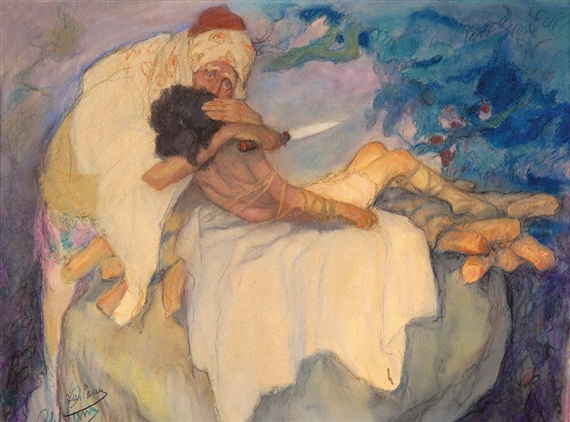
Artwork by Abel Pann, The Sacrifice of Isaac,
1st Reading (Track 1):  Genesis 22:1-14
This story can only be described as terrifying and repulsive. What kind of God would ask such a thing, for a parent to murder a child? Is this any kind of reasonable test of one’s obedience to God? These are questions that come down through the centuries about this text, and perhaps they are the very reason it exists. There is something of a parallel with the Flood story, with the promise that God will not do such a thing again, meaning that Israel’s God is not like the gods of the nations. Yet something odd happens in the flow of the larger story. In verse 19 it is said that Abraham and his servants returned. There is no mention of Isaac, not even in the story of the death of his mother in chapter 24.  He does not speak in the text until after the death of his father.

22:1 After these things God tested Abraham. He said to him, “Abraham!” And he said, “Here I am.” 2 He said, “Take your son, your only son Isaac, whom you love, and go to the land of Moriah, and offer him there as a burnt offering on one of the mountains that I shall show you.” 3 So Abraham rose early in the morning, saddled his donkey, and took two of his young men with him, and his son Isaac; he cut the wood for the burnt offering, and set out and went to the place in the distance that God had shown him. 4 On the third day Abraham looked up and saw the place far away. 5 Then Abraham said to his young men, “Stay here with the donkey; the boy and I will go over there; we will worship, and then we will come back to you.” 6 Abraham took the wood of the burnt offering and laid it on his son Isaac, and he himself carried the fire and the knife. So the two of them walked on together. 7 Isaac said to his father Abraham, “Father!” And he said, “Here I am, my son.” He said, “The fire and the wood are here, but where is the lamb for a burnt offering?” 8 Abraham said, “God himself will provide the lamb for a burnt offering, my son.” So the two of them walked on together. 9 When they came to the place that God had shown him, Abraham built an altar there and laid the wood in order. He bound his son Isaac, and laid him on the altar, on top of the wood. 10 Then Abraham reached out his hand and took the knife to kill his son. 11 But the angel of the Lord called to him from heaven, and said, “Abraham, Abraham!” And he said, “Here I am.” 12 He said, “Do not lay your hand on the boy or do anything to him; for now I know that you fear God, since you have not withheld your son, your only son, from me.” 13 And Abraham looked up and saw a ram, caught in a thicket by its horns. Abraham went and took the ram and offered it up as a burnt offering instead of his son. 14 So Abraham called that place “The Lord will provide”; as it is said to this day, “On the mount of the Lord it shall be provided.”

Psalm 13 (Track 1)
Psalm 13 is an individual’s lament that God has seemed to forsaken him or her.  The question, “How long?” haunts the psalm, even though it resolves into praise.

1    How long, O Lord?
      will you forget me for ever? *
                how long will you hide your face from me?
2    How long shall I have perplexity in my mind,
      and grief in my heart, day after day? *
                how long shall my enemy triumph over me?
3    Look upon me and answer me, O Lord my God; *
                give light to my eyes, lest I sleep in death;
4    Lest my enemy say, “I have prevailed over him,” *
                and my foes rejoice that I have fallen.
5    But I put my trust in your mercy; *
                my heart is joyful because of your saving help.
6    I will sing to the Lord, for he has dealt with me richly; *
                I will praise the Name of the Lord Most High.

1st Reading (Track 2):  Jeremiah 28:5-9
The prophet Jeremiah has spent chapter 27 prophesying the final exile of Israel into Babylon, in such strong terms that at one point he refers to the King of Babylon, Nebuchadnezzar as “God’s servant.” The rise of the empire and the exile of the people is God’s own intent. The prophet Hananiah, at the beginning of chapter 28, disputes these claims, trusting in God’s dedication to the temple and the city. Jeremiah responds in our text today. He expresses a kind of wistfulness that Hananiah be right, although his opening word, “Amen!” could be heard dripping with sarcasm. He argues that Hananiah’s optimism, however, is not in the line of the prophetic tradition, which is not to comfort, but to challenge. The proof will be, as they say, in the pudding. If there is peace, Hananiah will have been proved right (he was not).

28:5 The prophet Jeremiah spoke to the prophet Hananiah in the presence of the priests and all the people who were standing in the house of the Lord; 6 and the prophet Jeremiah said, “Amen! May the Lord do so; may the Lord fulfill the words that you have prophesied, and bring back to this place from Babylon the vessels of the house of the Lord, and all the exiles. 7 But listen now to this word that I speak in your hearing and in the hearing of all the people. 8 The prophets who preceded you and me from ancient times prophesied war, famine, and pestilence against many countries and great kingdoms. 9 As for the prophet who prophesies peace, when the word of that prophet comes true, then it will be known that the Lord has truly sent the prophet.”

Psalm 89:1-4, 15-18
Our psalm text this morning is from a much longer psalm. The first half of the psalm (vv. 1-18) is a hymn of praise for God’s faithfulness to his covenant with David. Verses 19-37 rehearse this covenant in poetic terms. The end of the psalm turns into a lament, asking the question, “How long will you hide yourself, O Lord?” (v. 46). God seems to have broken his covenant.  As a response to our first reading, the portion we have sounds like something that would come from the lips of the ever-optimistic Hananiah, and it seems that Jeremiah’s pessimism is what ends the psalm.

1    Your love, O Lord, for ever will I sing; *
                from age to age my mouth will proclaim your faithfulness.
2    For I am persuaded that your love is established for ever; *
                you have set your faithfulness firmly in the heavens.
3    “I have made a covenant with me chosen one; *
                I have sworn an oath to David my servant:
4    I will establish your live for ever, *
                and preserve your throne for all generations.”
15 Happy are the people who know the festal shout! *
                They walk, O Lord, in the light of your presence.
16 They rejoice daily in your Name; *
                they are jubilant in your righteousness.
17 For you are the glory of their strength, *
                and by your favor our might is exalted.
18 Truly, the Lord is our ruler; *
                the Holy One of Israel is our King.


2nd Reading:  Romans 6:12-23
In the first part of chapter six, Paul has eloquently summed up his argument that we are saved by grace, buried in baptism into Christ’s death and raised with him to new life.  The question now is, what then of sin? Is it inconsequential because it is not following the law that saves us?  No. Obedience to God is natural to those who have renounced sin. He calls it an “obedience from the heart,” one that flows from love not from fear. In Paul’s overview of the Christian life, salvation is God’s free gift, and sanctification is the journey of obedience we walk toward eternal life.

6:12 Therefore, do not let sin exercise dominion in your mortal bodies, to make you obey their passions. 13 No longer present your members to sin as instruments of wickedness, but present yourselves to God as those who have been brought from death to life, and present your members to God as instruments of righteousness. 14 For sin will have no dominion over you, since you are not under law but under grace. 15 What then? Should we sin because we are not under law but under grace? By no means! 16 Do you not know that if you present yourselves to anyone as obedient slaves, you are slaves of the one whom you obey, either of sin, which leads to death, or of obedience, which leads to righteousness? 17 But thanks be to God that you, having once been slaves of sin, have become obedient from the heart to the form of teaching to which you were entrusted, 18 and that you, having been set free from sin, have become slaves of righteousness. 19 I am speaking in human terms because of your natural limitations. For just as you once presented your members as slaves to impurity and to greater and greater iniquity, so now present your members as slaves to righteousness for sanctification. 20 When you were slaves of sin, you were free in regard to righteousness. 21 So what advantage did you then get from the things of which you now are ashamed? The end of those things is death. 22 But now that you have been freed from sin and enslaved to God, the advantage you get is sanctification. The end is eternal life. 23 For the wages of sin is death, but the free gift of God is eternal life in Christ Jesus our Lord.

The Holy Gospel:  Matthew 10:40-42
The whole of chapter ten has consisted of instructions for disciples sent forth to teach the things that Jesus has taught and do the things he has done. These final verses focus on hospitality. Mutual welcome and support are a defining characteristic of communities of disciples. A question long asked is, who are “these little ones?” Is Jesus talking about the disciples themselves, or, perhaps in the context of Matthew’s community, new disciples? Or is it a reference to the vulnerable who are often not welcomed easily in society, Matthew’s or ours?  They are good questions with which to wrestle. The important point is the juxtaposition of hospitality and righteousness.

10:40 Jesus said, “Whoever welcomes you welcomes me, and whoever welcomes me welcomes the one who sent me. 41 Whoever welcomes a prophet in the name of a prophet will receive a prophet’s reward; and whoever welcomes a righteous person in the name of a righteous person will receive the reward of the righteous; 42 and whoever gives even a cup of cold water to one of these little ones in the name of a disciple—truly I tell you, none of these will lose their reward.”


The Scripture quotations (except for the psalm) are from the New Revised Standard Version Bible, copyright © 1989 by the Division of Christian Education of the National Council of Churches of Christ in the U.S.A., and are used by permission.  All rights reserved.  The Collect of the Day and the Psalm translation are from The Book of Common Prayer.  Commentaries are copyright © 2017 Epiphany ESources, 67 E. Main St., Hornell, NY 14843. www.EpiphanyEsources.com. All rights reserved. Permission is given to copy for congregational use with this attribution.
Monday, June 19, 2017

Proper 7A: The 3rd Sunday after Pentecost 201

First Reading (Track 1):  Genesis 21:8-21
After the birth of Isaac comes the dilemma. What of Ishmael, the son of Abraham born to the slave Hagar? In despair over her own barrenness, Sarah had encouraged Abraham to have the child (16:1-2), but now sees him as a threat to the child of the promise. Hagar is sent away with another promise of God, that he will also make Ishmael a great nation. He will return in chapter 25 to help bury his father, and his descendants shall be named—12 sons, just as the 12 grandsons of Isaac. The Ishmaelites will be mentioned again—it is they who sell Joseph into slavery in Egypt. Muslims claim Ishmael as their ancestor, meaning that Judaism, Christianity and Islam share a common ancestor: Abraham. Hence they are sometimes referred to as the “Abrahamic faiths.”

21:8 The child grew, and was weaned; and Abraham made a great feast on the day that Isaac was weaned. 9 But Sarah saw the son of Hagar the Egyptian, whom she had borne to Abraham, playing with her son Isaac. 10 So she said to Abraham, “Cast out this slave woman with her son; for the son of this slave woman shall not inherit along with my son Isaac.” 11 The matter was very distressing to Abraham on account of his son. 12 But God said to Abraham, “Do not be distressed because of the boy and because of your slave woman; whatever Sarah says to you, do as she tells you, for it is through Isaac that offspring shall be named for you. 13 As for the son of the slave woman, I will make a nation of him also, because he is your offspring.” 14 So Abraham rose early in the morning, and took bread and a skin of water, and gave it to Hagar, putting it on her shoulder, along with the child, and sent her away. And she departed, and wandered about in the wilderness of Beer-sheba. 15 When the water in the skin was gone, she cast the child under one of the bushes. 16 Then she went and sat down opposite him a good way off, about the distance of a bowshot; for she said, “Do not let me look on the death of the child.” And as she sat opposite him, she lifted up her voice and wept. 17 And God heard the voice of the boy; and the angel of God called to Hagar from heaven, and said to her, “What troubles you, Hagar? Do not be afraid; for God has heard the voice of the boy where he is. 18 Come, lift up the boy and hold him fast with your hand, for I will make a great nation of him.” 19 Then God opened her eyes and she saw a well of water. She went, and filled the skin with water, and gave the boy a drink. 20 God was with the boy, and he grew up; he lived in the wilderness, and became an expert with the bow. 21 He lived in the wilderness of Paran; and his mother got a wife for him from the land of Egypt.

Psalm 86:1-10, 16-17 (Track 1)
Psalm 86 is a song of lament, from the lips of one who has no resources for life. It could easily have come from the lips of Hagar, as she despaired for the life of her son, directly addressing God (note the repeated “you” and “your.” Verse 9 is especially poignant given the history of Ishmael (as noted above).

1    Bow down your ear, O Lord, and answer me, *
                for I am poor and in misery.
2    Keep watch over my life, for I am faithful; *
                save your servant who puts his trust in you.
3    Be merciful to me, O Lord, for you are my God; *
                I call upon you all the day long.
4    Gladden the soul of your servant, *
                for to you, O Lord, I life up my soul.
5    For you, O Lord, are good and forgiving, *
                and great is your love to all who call upon you.
6    Give ear, O Lord to my prayer, *
                and attend to the voice of my supplications.
7    In the time of my trouble I will call upon you, *
                For you will answer me.
8    Among the gods there is none like you, O Lord, *
                nor anything like your works.
9    All nations you have made will come and
                                                worship you, O Lord, *
                and glorify your Name.
10 For you are great; you do wondrous things; *
                and you alone are God.
16 Turn to me and have mercy upon me; *
                give your strength to your servant;
                and save the child of your handmaid.
17 Show me a sign of your favor,
      so that those who hate me may see it and be ashamed; *
                Because you, O Lord, have helped me and comforted me.

First Reading (Track 2):  Jeremiah 20:7-13
In chapter 19, Jeremiah’s witness against the religious establishment reaches its peak when he cries the word of the Lord with the temple precincts, “I am now bringing upon this city…all the disaster that I have pronounced… (19:15). Jeremiah is then arrested by Pashur, the chief priest and put in stocks, but even in confinement he continues to predict disaster and even exile (20:1-6). In our passage today, having heard this harsh truth, we are given a glimpse of Jeremiah’s conversation with God and the personal cost he has paid. God has put him in a “no-win” situation. He believes his life is seriously threatened. Then v. 12 abruptly returns to trust. He cannot prevail, but God can, and then, like many of the complaint psalms, there is a final resolve into praise. Yet the lament is not over. In vv.14-18, Jeremiah cries out that he wishes he had never been born.

20:7 O Lord, you have enticed me, and I was enticed; you have overpowered me, and you have prevailed. I have become a laughingstock all day long; everyone mocks me. 8 For whenever I speak, I must cry out, I must shout, “Violence and destruction!” For the word of the Lord has become for me a reproach and derision all day long. 9 If I say, “I will not mention him, or speak any more in his name,” then within me there is something like a burning fire shut up in my bones; I am weary with holding it in, and I cannot. 10 For I hear many whispering: “Terror is all around! Denounce him! Let us denounce him!” All my close friends are watching for me to stumble. “Perhaps he can be enticed, and we can prevail against him, and take our revenge on him.” 11 But the Lord is with me like a dread warrior; therefore my persecutors will stumble, and they will not prevail. They will be greatly shamed, for they will not succeed. Their eternal dishonor will never be forgotten. 12 O Lord of hosts, you test the righteous, you see the heart and the mind; let me see your retribution upon them, for to you I have committed my cause. 13 Sing to the Lord; praise the Lord! For he has delivered the life of the needy from the hands of evildoers.

Psalm 69:8-11, (12-17), 18-20 (Track 2)
This portion of Psalm 69 could easily have been on the lips of the prophet Jeremiah. It is the lament of a righteous person who has suffered for it. Christians from the very beginning have identified its words with the suffering of Jesus, and, indeed, parts of it are used eight times, including v. 21 (not included here) referencing vinegar as a “gift” to the sufferer.

8    Surely, for your sake have I suffered reproach, *
                and shame has covered my face.
9    I have become a stranger to my own kindred, *
                an alien to my mother’s children.
10 Zeal for your house has eaten me up; *
          the scorn of those who scorn you has fallen upon me.
11 I humbled myself with fasting, *
                but that was turned to my reproach.
[12          I put on sack-cloth also, *
                and became a byword among them.
13 Those who sit at the gate murmur against me, *
                and the drunkards make songs about me.
14 But as for me, this is my prayer to you, *
                at the time you have set, O Lord:
15 In your great mercy, O God, *
                answer me with your unfailing help.
16 Save me from the mire; do not let me sink; *
                let me be rescued from those who hate me
                and out of the deep waters.
17 Let not the torrent of waters wash over me,
      neither let the deep swallow me up; *
                do not let the Pit shut its mouth upon me.]
18 Answer me, O Lord, for your love is kind; *
                in your great compassion, turn to me.
19 “Hide not your face from your servant; *
                be swift and answer me, for I am in distress.
20 Draw near to me and redeem me; *
                because of my enemies deliver me.

Second Reading:  Romans 6:1b-11
This passage is perhaps Paul’s clearest in proclaiming what we call “the paschal mystery.” Through our Baptism we participate in this mystery, and it becomes the pattern of our life. This assertion makes this passage the epistle reading at the Great Vigil of Easter. Although Paul speaks here as if we should never sin, he knows personally that is not the case (see 7:21-25). Our life in Christ, however, means that as many times as we fall into sin, we are set free by Christ’s death to live in his resurrection.

1b Should we continue in sin in order that grace may abound? 2 By no means! How can we who died to sin go on living in it? 3 Do you not know that all of us who have been baptized into Christ Jesus were baptized into his death? 4 Therefore we have been buried with him by baptism into death, so that, just as Christ was raised from the dead by the glory of the Father, so we too might walk in newness of life. 5 For if we have been united with him in a death like his, we will certainly be united with him in a resurrection like his. 6 We know that our old self was crucified with him so that the body of sin might be destroyed, and we might no longer be enslaved to sin. 7 For whoever has died is freed from sin. 8 But if we have died with Christ, we believe that we will also live with him. 9 We know that Christ, being raised from the dead, will never die again; death no longer has dominion over him. 10 The death he died, he died to sin, once for all; but the life he lives, he lives to God. 11 So you also must consider yourselves dead to sin and alive to God in Christ Jesus.

Gospel Reading:  Matthew 10:24-39
We continue Jesus’ preparation of the disciples to be sent out to extend his work. He prepares them for difficult work. This passage contains several of Jesus’ harder sayings. They are, however, permeated with the encouragement not to fear (vv. 26, 28, 31), except in the ultimate judgment of God. “I have not come to bring peace but a sword,” is not a call to bloodshed, but a recognition that following Jesus is likely to cause divisions, as vv. 35-36 say. Luke, in fact, changes the word “sword” to “division” so as not to bring misunderstanding.

10:24 Jesus said to the twelve apostles, “A disciple is not above the teacher, nor a slave above the master; 25 it is enough for the disciple to be like the teacher, and the slave like the master. If they have called the master of the house Beelzebul, how much more will they malign those of his household! 26 So have no fear of them; for nothing is covered up that will not be uncovered, and nothing secret that will not become known. 27 What I say to you in the dark, tell in the light; and what you hear whispered, proclaim from the housetops. 28 Do not fear those who kill the body but cannot kill the soul; rather fear him who can destroy both soul and body in hell. 29 Are not two sparrows sold for a penny? Yet not one of them will fall to the ground apart from your Father. 30 And even the hairs of your head are all counted. 31 So do not be afraid; you are of more value than many sparrows. 32 Everyone therefore who acknowledges me before others, I also will acknowledge before my Father in heaven; 33 but whoever denies me before others, I also will deny before my Father in heaven. 34 Do not think that I have come to bring peace to the earth; I have not come to bring peace, but a sword. 35 For I have come to set a man against his father, and a daughter against her mother, and a daughter-in-law against her mother-in-law; 36 and one’s foes will be members of one’s own household. 37 Whoever loves father or mother more than me is not worthy of me; and whoever loves son or daughter more than me is not worthy of me; 38 and whoever does not take up the cross and follow me is not worthy of me. 39 Those who find their life will lose it, and those who lose their life for my sake will find it.”


The Scripture quotations (except for the psalm) are from the New Revised Standard Version Bible, copyright © 1989 by the Division of Christian Education of the National Council of Churches of Christ in the U.S.A., and are used by permission.  All rights reserved.  The Collect of the Day and the Psalm translation are from The Book of Common Prayer.  Commentaries are copyright © 2017 Epiphany ESources, 67 E. Main St., Hornell, NY 14843. www.EpiphanyEsources.com. All rights reserved. Permission is given to copy for congregational use with this attribution.

Monday, June 12, 2017

2 Pentecost, Proper 6A, Readings & Commentaries

The Twelve Disciples
First Reading (Track 1):  Genesis 18:1-15 (21:1-7)
This story is rich in biblical fundamentals. The tendency is to focus on confusion regarding the “visitors.” Is it the Lord (v.1, vv. 13-15) or is “three men (vv. 2-12). Christians have wanted to see the Trinity at work here, but that is surely not the agenda of the text. More important are two crucial matters:  First of all, the biblical mandate of hospitality, a mandate of the highest priority. Second of all is the question, “Is anything too wonderful for the Lord?” Abraham and Sarah are not ready to believe this in their advanced old age. They are “as good as dead” (Hebrews 11:12). Yet as we skip to chapter 21, the Lord defies their doubt and they laugh not in doubt but in joy. The birth of Isaac is a critical moment in the biblical story. Without the possibility that God can shatter our impossibilities and make them new, there is, in fact, no biblical story at all.

18:1 The Lord appeared to Abraham by the oaks of Mamre, as he sat at the entrance of his tent in the heat of the day. 2 He looked up and saw three men standing near him. When he saw them, he ran from the tent entrance to meet them, and bowed down to the ground. 3 He said, “My lord, if I find favor with you, do not pass by your servant. 4 Let a little water be brought, and wash your feet, and rest yourselves under the tree. 5 Let me bring a little bread, that you may refresh yourselves, and after that you may pass on—since you have come to your servant.” So they said, “Do as you have said.” 6 And Abraham hastened into the tent to Sarah, and said, “Make ready quickly three measures of choice flour, knead it, and make cakes.” 7 Abraham ran to the herd, and took a calf, tender and good, and gave it to the servant, who hastened to prepare it. 8 Then he took curds and milk and the calf that he had prepared, and set it before them; and he stood by them under the tree while they ate. 9 They said to him, “Where is your wife Sarah?” And he said, “There, in the tent.” 10 Then one said, “I will surely return to you in due season, and your wife Sarah shall have a son.” And Sarah was listening at the tent entrance behind him. 11 Now Abraham and Sarah were old, advanced in age; it had ceased to be with Sarah after the manner of women. 12 So Sarah laughed to herself, saying, “After I have grown old, and my husband is old, shall I have pleasure?” 13 The Lord said to Abraham, “Why did Sarah laugh, and say, ‘Shall I indeed bear a child, now that I am old?’ 14 Is anything too wonderful for the Lord? At the set time I will return to you, in due season, and Sarah shall have a son.” 15 But Sarah denied, saying, “I did not laugh;” for she was afraid. He said, “Oh yes, you did laugh.”
[21:1 The Lord dealt with Sarah as he had said, and the Lord did for Sarah as he had promised. 2 Sarah conceived and bore Abraham a son in his old age, at the time of which God had spoken to him. 3 Abraham gave the name Isaac to his son whom Sarah bore him. 4 And Abraham circumcised his son Isaac when he was eight days old, as God had commanded him. 5 Abraham was a hundred years old when his son Isaac was born to him. 6 Now Sarah said, “God has brought laughter for me; everyone who hears will laugh with me.” 7 And she said, “Who would ever have said to Abraham that Sarah would nurse children? Yet I have borne him a son in his old age.”]

Psalm 116:1, 10-17 (Track 1)
Psalm 116 is a song of thanksgiving for deliverance from something that has threatened life itself. Part of the psalm’s vision is that fulfilling one’s vows to the Lord (a sacrifice of thanksgiving) brings salvation and freedom.

1      I love the Lord, because he has heard the voice of
                                                my supplication, *
                because he has inclined his ear to me whenever
                                                I called upon him.
10   How shall I repay the Lord *
                for all the good things he has done for me?.
11   I will lift up the cup of salvation *
                and call upon the Name of the Lord.
12   I will fulfill my vows to the Lord *
                in the presence of all his people.
13   Precious in the sight of the Lord *
                is the death of his servants.
14   O Lord, I am your servant; *
                I am your servant and the child of your handmaid;
                you have freed me from my bonds.
15   I will offer you the sacrifice of thanksgiving *
                and call upon the Name of the Lord.
16   I will fulfill my vows to the Lord *
                in the presence of all his people,
17   In the courts of the Lord’s house, *
                in the midst of you, O Jerusalem. Hallelujah!

Or this
First Reading (Track 2):  Exodus 19:2-8a
After having escaped from Egypt, the Israelites camped at Rephidim for a time. As chapter 19 begins, they are ready to start their journey through the wilderness. They had travelled until they reached “the mountain” (sometimes called Sinai, sometimes Horeb). Moses’ first trip up the mountain results in what we might call the “vision statement” for Israel:  They will be God’s special people, a holy nation (belonging to God) and a priestly kingdom (in God’s service). The commandments are yet to come, the means by which Israel will live (or not) into this vision.

19:2 When the people of Israel had journeyed from Rephidim, they entered the wilderness of Sinai, and camped in the wilderness; Israel camped there in front of the mountain. 3 Then Moses went up to God; the Lord called to him from the mountain, saying, “Thus you shall say to the house of Jacob, and tell the Israelites:  4 You have seen what I did to the Egyptians, and how I bore you on eagles’ wings and brought you to myself. 5 Now therefore, if you obey my voice and keep my covenant, you shall be my treasured possession out of all the peoples. Indeed, the whole earth is mine, 6 but you shall be for me a priestly kingdom and a holy nation. These are the words that you shall speak to the Israelites.” 7 So Moses came, summoned the elders of the people, and set before them all these words that the Lord had commanded him. 8 The people all answered as one: "Everything that the Lord has spoken we will do.”

Psalm 100 (Track 2)
Psalm 116 is a song of thanksgiving for deliverance from something that has threatened life itself. Part of the psalm’s vision is that fulfilling one’s vows to the Lord (a sacrifice of thanksgiving) brings salvation and freedom.

1    Be joyful in the Lord, all you lands; *
          serve the Lord with gladness
                and come before his presence with a song.
2    Know this: The Lord himself is God; *
                he himself has made us, and we are his;
                we are his people and the sheep of his pasture.
3    Enter his gates with thanksgiving;
                go into his courts with praise; *
                give thanks to him and call upon his Name.
4    For the Lord is good;
      his mercy is everlasting; *
                and his faithfulness endures from age to age.

Second Reading:  Romans 5:1-8
Paul has spent the first four chapters of Romans arguing the point that we are justified by faith and not by any works of the law. So, he says, here are the consequences of this truth.  It is peace with God and the hope of sharing glory with God. This hope cannot disappoint, even in the face of suffering, because no matter our state, Christ died for us, proving God’s love.

5:1 Therefore, since we are justified by faith, we have peace with God through our Lord Jesus Christ, 2 through whom we have obtained access to this grace in which we stand; and we boast in our hope of sharing the glory of God. 3 And not only that, but we also boast in our sufferings, knowing that suffering produces endurance, 4 and endurance produces character, and character produces hope, 5 and hope does not disappoint us, because God’s love has been poured into our hearts through the Holy Spirit that has been given to us. 6 For while we were still weak, at the right time Christ died for the ungodly. 7 Indeed, rarely will anyone die for a righteous person—though perhaps for a good person someone might actually dare to die. 8 But God proves his love for us in that while we still were sinners Christ died for us.

Gospel Reading:  Matthew 9:35—10:8 (9-23)
We pick up Matthew’s Gospel after the Sermon on the Mount (chs. 5-7) and a number of healing stories. The end of chapter 9 serves as a summary of what has happened with a transition sentence:  Jesus longs for laborers to go out as he has done. Matthew begins chapter 10 with a “summoning” of the 12, who are named. They are then sent with specific instructions and a warning about potential suffering. The good news they are called to spread will not be good news for everyone.

9:35 Jesus went about all the cities and villages, teaching in their synagogues, and proclaiming the good news of the kingdom, and curing every disease and every sickness. 36 When he saw the crowds, he had compassion for them, because they were harassed and helpless, like sheep without a shepherd. 37 Then he said to his disciples, “The harvest is plentiful, but the laborers are few; 38 therefore ask the Lord of the harvest to send out laborers into his harvest.” 10:1 Then Jesus summoned his twelve disciples and gave them authority over unclean spirits, to cast them out, and to cure every disease and every sickness. 2 These are the names of the twelve apostles: first, Simon, also known as Peter, and his brother Andrew; James son of Zebedee, and his brother John; 3 Philip and Bartholomew; Thomas and Matthew the tax collector; James son of Alphaeus, and Thaddaeus; 4 Simon the Cananaean, and Judas Iscariot, the one who betrayed him. 5 These twelve Jesus sent out with the following instructions: “Go nowhere among the Gentiles, and enter no town of the Samaritans, 6 but go rather to the lost sheep of the house of Israel. 7 As you go, proclaim the good news, ‘The kingdom of heaven has come near.’ 8 Cure the sick, raise the dead, cleanse the lepers, cast out demons. You received without payment; give without payment.
[10:9 Take no gold, or silver, or copper in your belts, 10 no bag for your journey, or two tunics, or sandals, or a staff; for laborers deserve their food. 11 Whatever town or village you enter, find out who in it is worthy, and stay there until you leave. 12 As you enter the house, greet it. 13 If the house is worthy, let your peace come upon it; but if it is not worthy, let your peace return to you. 14 If anyone will not welcome you or listen to your words, shake off the dust from your feet as you leave that house or town. 15 Truly I tell you, it will be more tolerable for the land of Sodom and Gomorrah on the day of judgment than for that town. 16 “See, I am sending you out like sheep into the midst of wolves; so be wise as serpents and innocent as doves. 17 Beware of them, for they will hand you over to councils and flog you in their synagogues; 18 and you will be dragged before governors and kings because of me, as a testimony to them and the Gentiles. 19 When they hand you over, do not worry about how you are to speak or what you are to say; for what you are to say will be given to you at that time; 20 for it is not you who speak, but the Spirit of your Father speaking through you. 21 Brother will betray brother to death, and a father his child, and children will rise against parents and have them put to death; 22 and you will be hated by all because of my name. But the one who endures to the end will be saved. 23 When they persecute you in one town, flee to the next; for truly I tell you, you will not have gone through all the towns of Israel before the Son of Man comes.]


The Scripture quotations (except for the psalm) are from the New Revised Standard Version Bible, copyright © 1989 by the Division of Christian Education of the National Council of Churches of Christ in the U.S.A., and are used by permission.  All rights reserved.  The Collect of the Day and the Psalm translation are from The Book of Common Prayer.  Commentaries are copyright © 2017 Epiphany ESources, 67 E. Main St., Hornell, NY 14843. www.EpiphanyEsources.com. All rights reserved. Permission is given to copy for congregational use with this attribution.